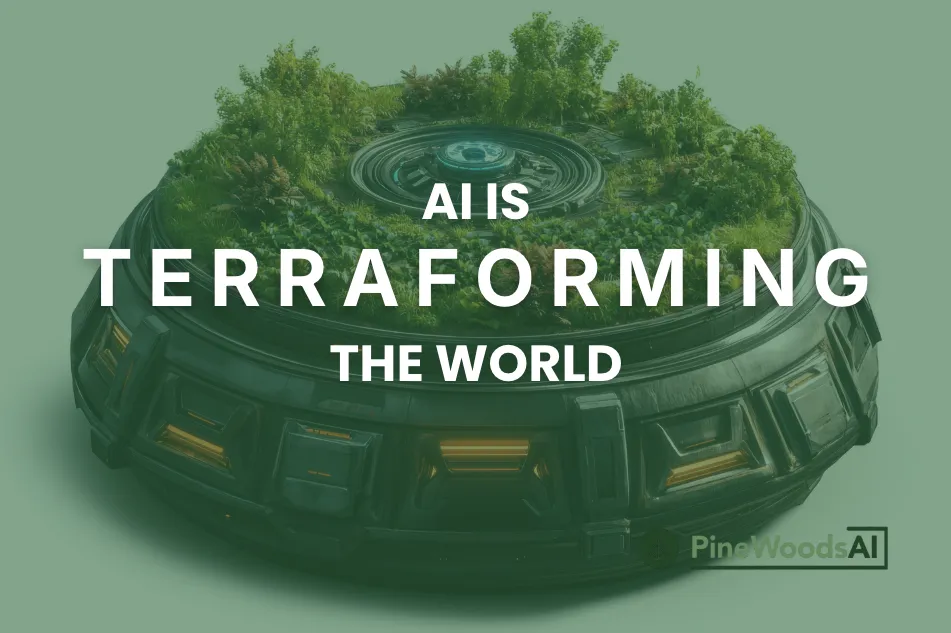
AI Is Terraforming the World
AI Is Terraforming the World
Software ate the world. Now, AI is terraforming it.
Beyond Disruption
A decade ago, Marc Andreessen declared that software was eating the world. He was right. Every industry, every institution, every interaction — software consumed them all.
But eating is just consumption. What's happening now is something different.
AI isn't eating the world. It's reshaping the ground itself. The terrain is changing. The rules are changing. The very nature of what's possible is being rewritten in real time.
This isn't disruption. Disruption implies a before and after — a stable state interrupted, then restabilized.
What we're experiencing is terraforming. The landscape won't settle back. It will keep shifting, accelerating, becoming something we don't yet have language for.
And most of us are standing on ground that's moving beneath our feet.
What Terraforming Actually Means
Terraforming is planetary engineering — transforming an environment to support new forms of life.
That's what AI is doing to human civilization.
It's not just automating tasks. It's changing what tasks exist. It's not just augmenting decisions. It's changing how decisions get made, who makes them, and what counts as a decision at all.
Consider what's already happening:
Knowledge is becoming ambient. What once required years of expertise can now be accessed in seconds. The value of knowing is collapsing; the value of understanding is rising.
Creation is becoming frictionless. Words, images, code, music — the barriers to producing them are dissolving. Scarcity of output is being replaced by scarcity of meaning.
Relationships are becoming mediated. More and more human connection passes through AI layers — filtered, summarized, optimized. Often without anyone noticing.
This isn't a tool being adopted. It's an environment being transformed.
Why This Moment Is Different
We've lived through technological revolutions before. Electricity. Automobiles. The internet. Each one reshaped society in profound ways.
But AI is different in kind, not just degree.
Previous technologies extended human capability. AI extends human cognition itself. It doesn't just help us do — it helps us think, perceive, decide.
And unlike previous technologies, AI learns. It adapts. It improves without human intervention. The tool itself is evolving.
This creates a feedback loop unprecedented in human history. The technology that shapes our thinking is being shaped by our thinking. The boundary between human and machine intelligence is blurring — not in some distant future, but now, in the tools we use every day.
The ground isn't just shifting. It's becoming something new.
What Most Responses Get Wrong
Faced with terraforming, most responses fall into familiar traps.
Denial. "This is just hype. It will settle down. Things will return to normal." They won't.
Acceleration without reflection. "Move fast, deploy everywhere, figure out consequences later." This is how civilizations make irreversible mistakes.
Fear without agency. "AI will destroy jobs, relationships, meaning — and there's nothing we can do." This surrenders the very thing that matters most: the choice of how to build.
Optimization without purpose. "Make everything more efficient, more productive, more engaging." But efficient toward what? Productive of what? Engaging for whom?
Each response treats AI as something happening to us rather than something being built by us.
But terraforming doesn't happen automatically. Someone chooses what the new world will look like. Someone decides what will be optimized and what will be preserved. Someone shapes whether the new environment supports human flourishing — or undermines it.
The question isn't whether AI will reshape the world. It's who will hold the tools, and what they'll build with them.
The Relational Imperative
Here's what most people miss: in a world being terraformed by intelligence, the scarcest resource isn't information. It isn't processing power. It isn't even attention.
It's connection.
As AI mediates more of human life, the quality of human relationships becomes more — not less — important. The ability to align, to trust, to understand each other, to coordinate action across difference — these capacities will determine which individuals, teams, organizations, and societies thrive in the new terrain.
Terraforming creates new ground. But humans still need to live on it. Together.
This is why relational intelligence matters now more than ever. Not as a nice-to-have. As infrastructure for whatever comes next.
The Intelligence Age will be defined not by which AIs are most powerful, but by whether AI serves or severs human connection.
That's the choice in front of us.
Building on Shifting Ground
The ground is moving. It won't stop.
But that doesn't mean we're powerless. It means we have to build differently — with foundations deep enough to hold, flexible enough to adapt, and principled enough to remain aligned with what matters.
Technology will continue to terraform the world. The question is whether we'll build relational intelligence into the new landscape — or leave connection as an afterthought, again.
We know which choice we're making.
PineWoodsAI is The Relational Intelligence Company.


